Monday, October 21, 2013

Letting Go

When I was younger, I never understood why my parents would be so worried about me if I was out with my friends, or coming home late at night.  Other parents, I thought, were not this "over-protective," and I felt frustrated, infantilized.

Well, now I think that they handled it well.  I was out with my friends, or with people they didn't know, driving on my own.  You are 2 1/2, and the people I leave you with are at daycare.  Or I leave you with your dad, who I know loves you and takes great care of you.

Today and tomorrow, you are spending the day with your Grammy Rogers, who loves you so very much and will also take great care of you:


And yet, I get this feeling deep in the pit of my stomach, like something is being ripped away from me. I now understand that, when you carry a baby around for nine months, you really do "connect" in a deep-seated way.  I also don't know what it's like to have a non-special-needs child, but taking you to therapy four times a week has really, I feel, cemented this bond between us.  It is just so very hard to "let go", even when I rationally know that these are people who love and care about you.

Don't worry--I'm working on this because I know it's healthy for you to develop independence, spend time with different people, etc.  I've been really trying to give you time alone with Daddy and, now, with Grammy, and I hope that you'll get some good alone time with Nagyi and Papa.

But it does make me realize how hard it is to let a child, any child, go.  And even if you don't have children, this holds true for every relationship we have in life.  The minute we have a bond with someone, we try and tie them even closer to us, thinking that the more we cling to them, the tighter the bond will be.

Paradoxically, trying to hold on so hard just makes things worse.  When we let go, people will come to us.  And, as the cliché says, loving is "letting go."  This morning, I thought about what that meant for God and His gift to us.  Whatever you believe, you have to admit that the story of Christianity is a beautiful story of selfless love.  I think about my love for you and then I think- "this is the kind of love God would have felt for His son."  Probably even moreso, since our love is always tainted with selfishness in some way.  So the fact that he sacrificed Jesus for us, that he "let go" enough to let His son die for us, is truly amazing.  I think about how I feel when Jules isn't with me for a few days, and then I think that God must truly have wept (or whatever the God version of weeping is) that day.

So I think Christianity has a lot to teach us about parenting.  While God did let go of Jesus for us, we are also His children, who he loves unconditionally.  And so (and this is the tough part to wrap my head around), he let go of His Son in order to redeem his sons and daughters.  And he let Him go so that he could fulfill his higher purpose.

Now don't get me wrong--I won't be sacrificing you any time soon, and this is a huge leap from giving you more alone time with other people.  But I do want you, too, to fulfill your "higher purpose," and I know I can't do that if I'm holding on to you too tightly.  So this year, as my spiritual discipline, I will work on "letting go," not despite my love for you, but because of it.

Tuesday, October 8, 2013

Nagyi

So today I want to go up a generation and write about your amazing grandmother, Nagyi (or mamama, as you call her).  Before any feelings get hurt, I want to emphasize that all of your grandparents are amazing, but this Thursday, your Nagyi is turning 70.  It's a huge milestone, and I wish she had you there to celebrate with her, as I know that would make her really happy.

Your grandmother is an incredibly strong woman who taught me everything I know about how to be a good, considerate person.  She has been through so much--when she was born in 1943, her family had to leave Transylvania because of Russian occupation.  Then, during communist rule in Hungary, her father, who was well educated, had to farm the land and, later, work on the railroads.

When she applied to college (as you will too someday!), she had to downplay her intelligence, and it actually hurt her case that she wasn't a communist.  Nonetheless, she finished college, earned the equivalent of a Masters degree, and taught high school French and Russian until she met my father and moved to the United States.

It wasn't easy for her to be in America, either.  Her teaching credentials didn't mean anything here in the states, and she would have had to re-do her degree.  Being European, she didn't drive, and she had to learn from my father (which, having also learned to drive from him, I can attest to being a somewhat traumatic experience).  She told me stories about being pregnant with me, home alone, and not knowing a single word of English.

Nonetheless, she learned English well and stayed home with us to make sure we had the best education possible.  I remember nights sitting and trying to figure out math homework.  I was always so impatient with math, my least favorite subject, but she always sat with me at that dining room table until I figured it out.  Later, she would quiz me in biology or read my English papers, always putting me, my brother, and our education first.

In the meantime, my father started having health issues, beginning with his lung cancer in 1986.  That was followed by a quintuple bypass and a number of other invasive surgeries.  My mom got a job at Caldor, the retail store where my father worked as a department manager, to pay our bills, and they continued to work long, hard hours (in a job where no one respected their intelligence).  Now, however, my mom also had the job of taking care of my father, which grew more and more taxing as he grew older.

And, of course, she took care of us, making sure that we had what we needed, me at Smith College, my brother, your uncle Julius, at Cornell University (not too shabby).  When my brother was in an accident, her and my dad drove up at night in order to check on him in the hospital.  When I left my violin at home, they came and brought it to me at Smith.  When, later on in life, I had a particularly bad year with my anxiety disorder, they came and stayed with me.  At one point, my mother even slept in my bed, holding my hand so that I could sleep.

My father's death in 2001 was incredibly hard on my mom, but she picked up, moved to an apartment, and then moved to Hungary to take care of her own parents.  Since then, she has traveled to the States, sublet in both Boulder and here in Charleston.  The last time she was here, she stayed on Folly Beach, where we took this picture:


Not only do you look a lot like her (!), but I hope you will be equally strong...and equally kind.  Your challenges might be different, but I know you will, unfortunately, face quite a few.  I hope you can think of her example and face them, as your Dédi would have said, with a smile on your face.  I hope you can fall down and get back up again.  Most of all, I hope that you will not be so overwhelmed with life's challenges that you forget to be kind.  When your grandpa had cancer, your Nagyi went door to door collecting money for the cancer society.  When someone needed food, she was always ready to bring it to them.  And, when I was in school, she would pick beautiful Jasmine flowers from our garden for me to bring to my teachers.

Always, she put other people before herself, so on Thursday, as she turns 70, I would like to put her first.  I would like for you to someday read this and understand the sacrifices she made so that I could have my education, have my job, meet your father, and eventually have you, the best gift anyone could ever ask for.  She is with me in spirit (and sometimes on the phone) when I have a rough day, when I do events for charities, when I try and help out people in need.  I know that I was a Daddy's Girl, but it is mostly my mom who made me the person I am.  Today, and every day, I celebrate that.

**I will be posting soon about the Buddy Walk, but I wanted to get this done before my mom's birthday!


Friday, August 23, 2013

Dédi

So I hope you know by now that Dédi means great-grandfather in Hungarian.  You have one picture of your great grandpa, Daddy's grandpa, in your room, although it never hurts to have more:
This is you with him on Thanksgiving, 2012, when you were still so little!  You've gained so much from him:  wonderful stories of his military service and his relationship with the love of his life, Jean (whose necklace you now have), an interest in how things work, and a love of books (you've had many people to inherit this from!).

Thankfully, you get to see him from time to time, though not as often as we would like.  Obviously, you have had four great-grandfathers, and today I'd like to tell you a bit about my very special grandpa, Dédi.

When your dad and I met, one of the first things we bonded over was the special relationship we both have (and had) with our grandfathers.  My grandfather, my mother's father, meant more to me than I can even express.  He was so full of love for everyone, as I think you can see from this, one of my last pictures of us:


When I was only eight years old, my grandfather started to teach me to play violin.  He was good--really good--and had played in orchestras, but one of his real interests was Hungarian folk music, so I learned a lot of folk tunes.  If you listen to the fiddle parts (here played by the flute) in Hungarian folk tunes, you'll hear that they are fast-paced, require dexterity, and, most of all, just need a lot of heart:


Tonight, I had my first experience trying to play bluegrass fiddle.  Although this is really different, connected to Appalachia and American mountain folk, it does have the fast-paced runs and, more importantly, that heart.  I played tonight at Bluegrass and Burgers, an event hosted by the Cathedral of St. Luke and St. Paul in Charleston (where we go), I felt that heart.  I felt that I was playing songs about something I cared about, my faith, that I was connected to people from generations back and, even though the traditions differ, that I was connected to my grandfather, your Dédi.

I've told this story before, but the day that he passed away was the day I had my first ultrasound and realized I had a viable pregnancy (I had been bleeding pretty badly, so I wasn't sure).  It was such a bittersweet day; I think your existence is the thing that honestly got me through the raw grief of losing someone so dear to me.  I also have always felt that you are connected to your ancestors; it's otherwise too much of a coincidence that I took the pregnancy test on the anniversary of my father's death, and I had the ultrasound on the day Dédi died.  You are proof that their spirit still lives.

And every time I play the violin, I feel that Dédi's spirit lives even more strongly.  As I played fiddle, you danced and clapped.  You listening to me play, and enjoying it, was like you listening to your Dédi.  I know he looked down from heaven and smiled.  All those years ago, when I barely squeaked out my first folk tune, he knew that he was giving me a great gift, and I now have the honor to give this gift, the gift of our heritage, of music, to you.

Saturday, August 17, 2013

Turning it Off?

I've been thinking a lot about this article that's been making its rounds on Facebook and on the internet:  http://www.sciencedaily.com/releases/2013/07/130717132330.htm

If you don't have the time to read it, here's one of the first sentences:  "the underlying genetic defect responsible for Down syndrome can be suppressed in cells in culture (in vitro)."  On my run this morning, I thought a lot about what this would mean.  Is it something that I, or our culture, would want?  Before I had you, the answer would have been an emphatic "yes."  Who wouldn't want their kid to have everything the world would give them?  Who would want for their child to be discriminated against or denied opportunities because of the way s/he is born?  

Sometimes I still feel this way.  When I see how you're working really hard to make the "h" sound and kids half your age are talking relatively proficiently, I wish I could "turn it off."  When I see other kids taking toys from you or literally stepping all over you, I wish I could "turn it off."  When I call a preschool and have them tell me that they are "not sure" they could "handle" someone with Down Syndrome, I wish to God I could "turn it off."  I hate that you will have these challenges in life.

And yet, what I did not know before I had you is the thing everyone who has kids with DS talks about.  Now I don't quite believe that they are "angels" (you can be a pain in the butt!) or that they are "magical," but you do have a different, pretty awesome way of looking at the world.  While other kids your age engage in histrionics (sorry- tantrums) or fight to get their way, you look at them, tilt your head, and take it all in.  You have about five teeth coming in right now, but you still play, laugh, and thoroughly enjoy Harry the Bunny.  Those of you who have kids with DS should check this out, by the way.  Jules just adores it:


We just got back from our big family vacation in NYC, and your responses were so interesting.  Instead of being afraid on the subway or on the streets, you waved at everyone and even reached out to feel people on the subway (we called you the "subway groper").  You have such pure, unadulterated joy when you get to swing in a park.  Here you are in a park in Montclair, NJ:

And my favorite thing was the way you were fascinated by the patterns on the concrete.  This is something I would never have thought to look at.  And then there is the way you make friends with everyone.  This is you at the airport in Charleston, before we even left.  Most 2-year-olds would have been clinging to mom and dad, but you went and befriended every kid in the place:
And so here's my question.  Would you be the same person without the DS?  Maybe this is just who you are, but maybe that extra chromosome is part of what makes you you.  Maybe it's part of who God wanted you to be.  It makes me think about the fact that, when I was a teenager, I was super self-conscious of a mole I have under my nose.  Kids picked on me about it, making the predicable remarks about it being a "booger," and even people in church told me to "blow my nose."  I wanted the darn thing gone and shed many a tear over it.
Now, I see it as part of me, part of the person God meant me to be.
On a more profound (perhaps) note, I have struggled with anxiety my entire life.  I'm convinced that it's just my chemical makeup, the way I'm made.  But getting rid of the anxiety altogether might have changed the person I am, like in those cheesy movies like Groundhog Day where one choice changes the entire outcome of events.
So I guess the way I see it is that the stupid mole, my anxiety disorder, and even something as big as Down Syndrome are God's choices.  They are the way God made us, and He made us that way for a reason.  Maybe you would be the same person without the DS, but chances are you would not.
Maybe you would be picked on less, ostracized less, welcomed with open arms into any preschool.
While I do want that for you--I always want the very best for you--, I wouldn't want it at the expense of the really interesting person you are becoming.  And while I never want you to struggle--no parent does--the struggles are part of what makes us who we are.
So I'm a bit wary about this kind of research that "promises" to get rid of this "defect" in vitro.  Maybe, in the future, we can get rid of unsightly moles or even depression and anxiety, but then what would we have?  We would have a generation of people who are "perfect":  perfectly flat.  And I'm convinced that this is not why God put us on this earth.  God put us here so we can enjoy each other, our differences, learn empathy from people with mental illness or cognitive disabilities...or just people who look and act "differently."  If the essence of being human means messing up, making mistakes, or just being imperfect, what would be the implication of "fixing" everything?

Wednesday, June 26, 2013

Summer 2013: May and June

I should just call this my summer blog, since this seems to be the the only time that I have time to post.  This summer, I've decided to take one day a week and spend it exclusively with you.  We've been having so much fun, and she is running all over the place.
The first place we went to was the Charleston Aquarium, and she was so very happy there!  When one walks in, one first sees a little marble display (even before the main entrance), and you spent about twenty minutes there:

Julia playing with the marbling- there is water flowing down

Once we finally got inside the aquarium, you really enjoyed the makeshift boat.  You really love climbing on things nowadays; in fact, you like to climb up on our coffeetables and stand on them!  Here you are peering out from behind the bars at the very top of this boat:


Thankfully, you also really enjoyed the fish (or maybe a combination of the fish and looking at your reflection in the tanks!).  You know you're beautiful, and I hope you never forget it!

look at me...errr, the fish

Our next mother-daughter outing was to the Angel Oak Tree, "one of the oldest living things in the country" (http://angeloaktree.com/), estimated to be between 400-500 years old.  For this reason, it's huge and makes for some good climbing (do you sense a theme?).  Here you are just enjoying the leaves, which were at least as fun for you as the tree.  You wanted to clear them all out of the way and spent a lot of time "sweeping" them:


You are also really interested in letters and words right now, and you pointed out every single letter on the sign requesting us to respect the tree.  Here you are pointing to one of the signs!  I'm hoping this means you learn to read early.

You say "dooh, dooh, dooh" while you point and count


To get a sense of how enormous this tree is, a tourist was kind enough to take a picture of the two of us, one of the few that I have (a downside to mother-daughter days).


So that's two trips down.  If I were a more conscientious blogger, I wouldn't put more than that into a blog, but please grab a glass of wine (if you're over 21) or a cup of coffee (if you're really my daughter), or come back to this if/when the spirit hits you.  Although your naptimes are widely disparate, you sometimes get the chance to play with your neighbor and friend, Ellie.  Ellie's parents have a trampoline, and you LOVE it.  Here are the two of you playing:


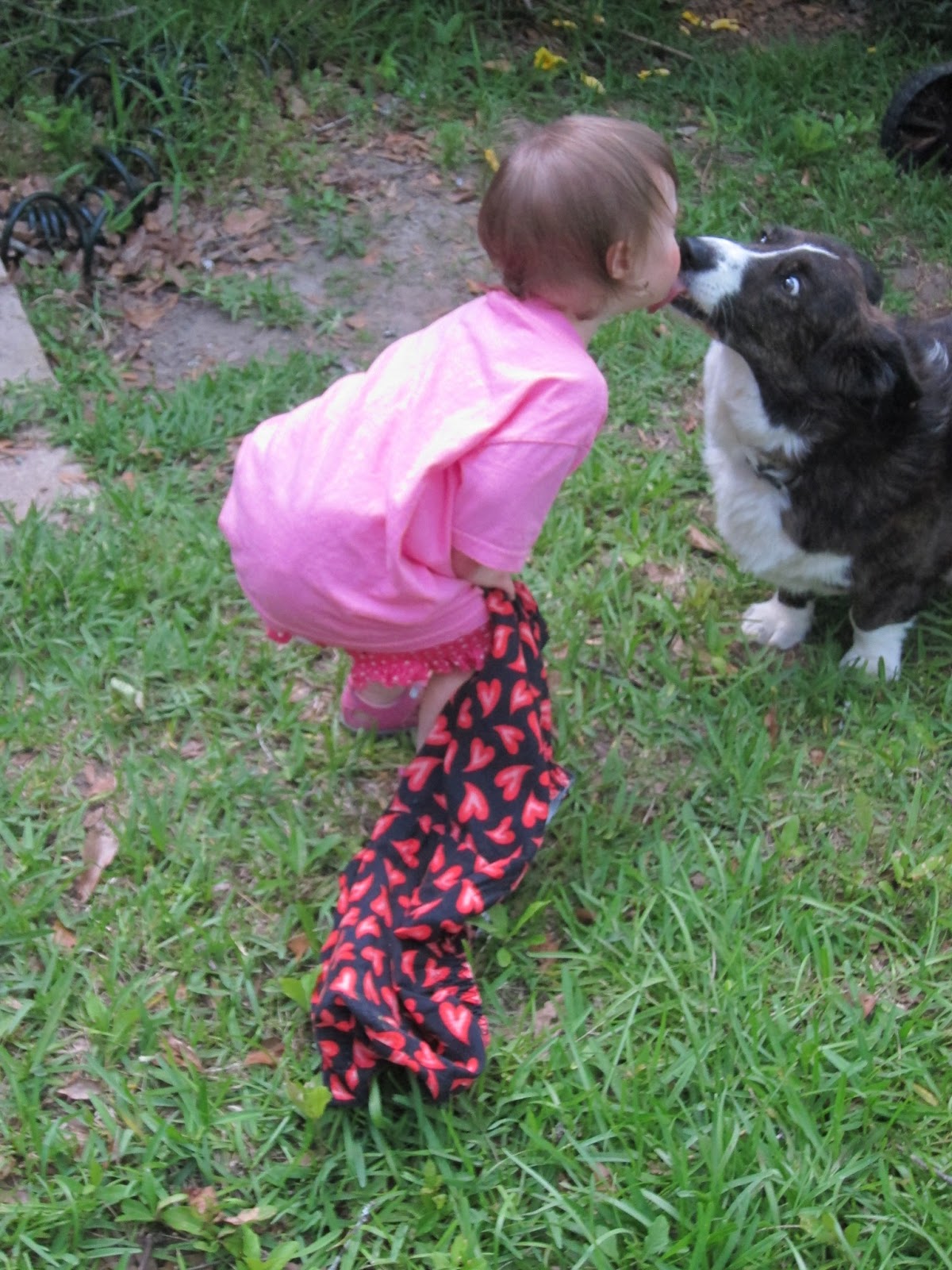
...but your very favorite playmate is Puck.  You chase him around, play with him, and give him sweet kisses.  Both of you stick your tongues out.  Can't figure out if it's cute or unhygienic, so I'm going with the former:


Mommy also took you to the children's museum, where I was too busy corraling you to get any decent pictures, but I did get this one of you playing with a sweet little boy:


And then sometimes we get to go to the playground with Daddy, another of your favorite playmates.  You have learned to sign "Da-da" and do it vociferously (if one can sign vociferously):


So now it's late June and I'll probably take you to James Island County park and take pictures of you splashing around this week.  Next week, Daddy and I are headed to a wedding in Asheville, and you get to stay with Grammy and Papa again!  Last time, when I went to a conference in Morgantown, you stayed with them, and Grammy took you to the nature center:


She also fed you lots of good food like Spaghetti, which I'm too obsessive compulsive to often give you.

That's the good thing about having a lot of parent figures like Grammy, Papa, and Nagyi: you will learn such different things from them, and every one of those things will make you a more well-rounded, adventuresome, thoughtful person.  Grammy is so adventuresome, and Daddy often tells stories of the little excursions she would take them on--here you are with her:


And Papa really nourishes that musical side of you, singing to you (one of your favorite activities) and really spending time talking to you.  Nagyi does those things too, and she is so good about making sure you practice your therapies.  You really do have some awesome grandparents, Jules!  I can't wait to see what you learn (and get into) during the next week.  But first, James Island County Park.  I will, at least over the summer, try and update this blog more often.


Wednesday, October 17, 2012

Buddy Walk & Advocacy


This year was Jules's second Buddy Walk, and it was so much better than the first!  Last time, it was just the three of us, but this time, we had Jim and Patty drive all the down from Charlotte and back (in one day!) to be there.  And we knew people, like Julia's therapist Beth, who stopped by our tent:
That was us:  "Fools for Jules."  It was actually one of my first art projects for Julia, which is why it looks like it was drawn by a child.  Nonetheless, it was a great time of family: both our immediate family and our new and ever-growing Down Syndrome family.

And this is the reason for this post.  In the spirit of advocacy for Down Syndrome Awareness Month, I attended a Webinar put on by the NDSS (National Down Syndrome Society) and the DSRTF (Down Syndrome Research and Treatment Foundation).  The latter is a lesser-known organization that funds research, partly through having a marathoning team (which I'll be joining when Julia is older and can come with me to Disney World!).

So please grab a cup of coffee or an alcoholic drink (is it after 3 p.m.?), and get ready to read my somewhat copious notes about the webinar.  I'm hoping that we can all learn something without all of you sacrificing an hour of your precious time~

The first thing I learned is that mice can have the equivalent of Down Syndrome, but instead of T21, they have an extra chromosome on their 65, so they are called Ts65Dn Mice.  They have similar facial features, shorter necks, and shorter limbs, just like humans:
Cute, huh?  It's like a Corgi mouse :).  Anyway, the interesting part is that they also have issues with spatial orientation, learning, and memory, and that scientists located these in the hippocampus of their brains--I don't want to know exactly how, since it probably involved the death of these Corgi-mice.
They also realized that the cerebellums (cerebelli?) of these mice are, like those of humans with DS, quite small.  Here's a great website that explains brain functions: http://serendip.brynmawr.edu/bb/kinser/Structure1.html.

In relation to the cerebellum size, the Arizona Cognitive Test Battery was performed on young adult mice, who took time out from drinking and partying to help out the cause.  They actually came up with a drug to restore the size of the cerebellum, but it was turned down by the NIH.  The exciting thing about this study is that, once cerebellum size was restored, the mice could do the same stuff as normal teenage mice.  The other exciting thing was that these mice were not babies, and that brain function could be impacted even later on in age.

A different, but no less important, study found that a specific set of neural connections is out of place in the Ts65Dn mice.  We all of excitatory and inhibitory stuff in our neural pathways, and mice with DS have too much of the later.  If scientists inhibit the inhibitory neurons, they can restore electrical conductors.  In order to inhibit said neurons, scientists used a drug, PTZ, and treated a mouse model.  In this article about PTZ, authors also mention side effects like severe seizures (effects that the webinar speakers conveniently left out).  They've started clinical trials of PTZ in Australia, and it seems successful; in fact, performance keeps improving for 2-3 months even after the drug is withdrawn.  So the big question is "how will this affect adaptive behaviors in humans?"  In other words, how will nature and nurture interact here?

I don't know how I feel about these drugs; I'd like to learn more about their side effects and make sure they are safe, but the prospects seem quite exciting!

The second part of the webinar (grab another coffee/drink here) was about advocacy.  There are five branches of action that the DSRTF is focusing on:
1) Drugs like PTZ and the cerebellum-growing-one
2) Sleep (??)
3) Behavioral Neuroscience
4) Alzheimer's - we'll get back to this in a bit
5) FUNDING.

An 8% across-the-board funding cut to the NIH has really hurt the congressional momentum of DS advocates.  Although DS has support across the aisle, there are many things that people can do.  The NDSS is working on establishing a patient registry; offering competitive grants for 6 Centers of Excellent (one of which should, I think, be in the Lowcountry!); fostering dialogue through the NIH DS consortium; and addressing Alzheimer's in collaboration with DS (since people with DS are highly likely to develop the condition).

How can you get involved and help people like Jules?  Check out the NDSS Online (link above); if you sign up, they will send you advocacy alerts.  I just signed up, and it took 1 minute (literally) of my time.  You can also join the DS Ambassadors Program, which builds liaisons between congressional delegations and the DS community.  Finally, you can attend the Washington DC Buddy Walk, which features an Advocacy Conference.

If you're reading this all as an adult, Jules, sorry it didn't sound much like a letter TO you, but I'm sure you will be involved at this point.  Hopefully, you can look back on this and read about the huge amounts of progress that have been made, not only in research and "treatment," but also in human treatment: in acceptance and inclusion.

And if any of you want to listen to the actual webinar, it's available on the NDSS website.  I wish I could post every day for DS awareness month, but I'm super busy with work and raising you, Jules...so I'm just writing more instead!


Sunday, October 7, 2012

WALKING!!

We are beyond excited.  Every day, you walk a few more steps; on Friday, you walked 8 steps total.  Well, today, you walked five in a row.  This is sooo huge for us.  We have been doing treadmill training with you for about 6 months now, and I'll have to videotape it for here.  But here it is: the videotape of you taking your very first steps:
And just in case any of you want to read about treadmill training and its benefits--if you're not convinced by our 20 month old practically walking!!--see this article.
I want to definitely write about the Buddy Walk, but I'll save that for tomorrow.  This is so huge that we all just want to savor it.  Love you!  Mom